


Dramatic in presentation, deeply satisfying in every bite.
It has roots in 19th-century Russian aristocratic cooking, later refined by the great French chef Escoffier, which perhaps explains why it feels both rustic and impossibly elegant at the same time. A dish with a story. A dish with soul.
If you’ve been looking for a centrepiece that genuinely earns its place on the table — for a dinner party, a celebration, or simply a weekend when you feel like cooking something extraordinary — this is it.

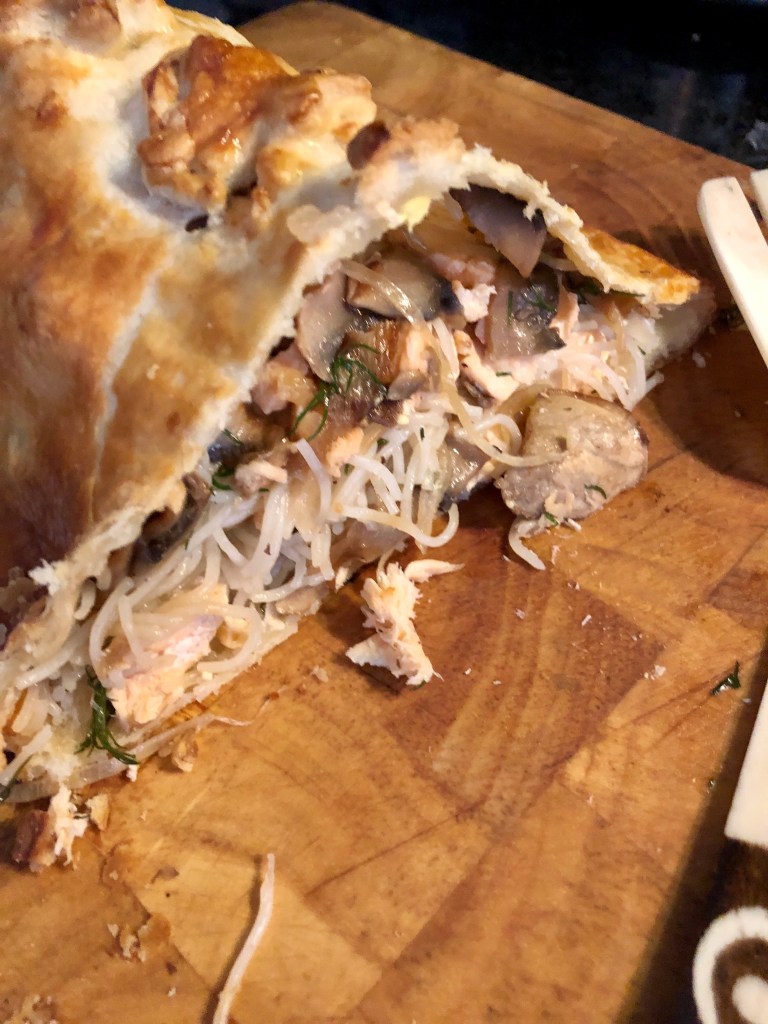
Difficulty Level : Medium – Preparation Time : 3 Hours including baking – Servings : 6 generous portions
INGREDIENTS
240 Ml. Dry white wine
1 celery stalks, cut into large pieces
1 carrot, peeled and cut into chunks
0.5 teaspoons black peppercorns
2 bay leaves
4 salmon fillets
2.5 Chinese rice noodles (dry)
1 Large Leek, cleaned and thinly sliced
0.5 cups fresh dill, roughly chopped
9-10 white mushrooms, thinly sliced
85 Gr. unsalted butter
2 hard-boiled eggs (optional)
Pinch Espelette pepper, salt and black pepper to taste
500 Gr. store-bought puff pastry
1 egg yolk
1 tablespoons whole milk
PREPARATION
Soak the noodles: Place 2 Chinese rice noodles (dry) in a large heatproof bowl and cover with boiling water.
Soak for 6 to 7 minutes — they should be tender but still have a little bite.
Drain, rinse under cold water, and set aside in a large mixing bowl. This will be your assembly bowl.
Build the court-bouillon: In a medium saucepan over medium heat, combine 240 milliliters dry white wine, 1 celery stalks, cut into large pieces, 1 carrot, peeled and cut into chunks, 0.5 teaspoons black peppercorns, and 2 bay leaves. Bring to a gentle boil and simmer for 10 minutes, until the vegetables have softened and released their fragrance.
Poach the salmon: Slide 4 salmon fillets into the court-bouillon. If needed, top up with a little water to ensure the fillets are just covered. Poach over low heat for 6 to 7 minutes.
The salmon should still be a deep, bright pink inside and appear barely cooked. This is intentional; it will finish in the oven. Drain and allow to cool at room temperature for 15 minutes, then flake into generous chunks directly into the noodle bowl.
Hard-boil the eggs (optional): If using 2 hard-boiled eggs (optional), lower them into a small saucepan of boiling water and cook for 7 minutes exactly. Transfer to cold water, peel once cool, and set aside.
Sauté the leeks and mushrooms: Melt half of 85 grams unsalted butter in a skillet over medium heat. Add 1 leek, cleaned and thinly sliced and cook gently until soft and translucent, about 5 minutes.
Tip into the assembly bowl. Return the pan to the heat, add the remaining butter, and sauté 9 white mushrooms, thinly sliced until lightly golden at the edges. Add to the bowl as well.
Season the filling: Add 0.5 cups fresh dill, roughly chopped to the bowl. Season generously with salt, black pepper, and 1 pinch Espelette pepper, salt and black pepper to taste.
Fold everything together with care — you want a cohesive filling, but those large flakes of salmon are part of what makes this dish special. Taste and adjust seasoning.
Heat your oven to 200°C (390°F). Line a large baking tray with parchment paper and set aside.
Roll and cut the pastry: On a lightly floured surface, roll out 500 grams store-bought puff pastry to about 3mm thick. Cut into two rectangles: a bottom sheet of approximately 20 × 52 cm, and a slightly larger top sheet of 22 × 54 cm — the extra width gives you enough to seal the edges comfortably.
Assemble the Coulibiac: Lay the smaller pastry sheet on the lined tray. Lightly brush a 2 cm border around the perimeter with water — this is your seal. Mound the filling down the centre of the pastry, leaving the border clear. If using hard-boiled eggs, lay the slices along the top of the filling in a single line. Drape the larger pastry sheet over the top, pressing firmly along the borders to seal. Crimp the edges with a fork all the way around. Using a sharp knife, score two or three small steam vents in the top.
Egg wash and bake: Whisk together 1 egg yolk and 1 tablespoons whole milk until smooth. Brush generously and evenly over the entire surface of the pastry. Bake for 20 to 20 minutes, until deeply golden and the pastry is puffed and crisp.
Rest and serve: Allow the Coulibiac to rest for 5 minutes before slicing. This helps the filling settle and makes for cleaner, more beautiful slices. Serve with a light crème fraîche or a simple green salad alongside.
Notes
Get ahead: The filling can be made entirely the day before and kept refrigerated overnight. Assemble and bake straight from the fridge the following day — just add 5 minutes to the bake time.
Freeze it: The assembled, unbaked Coulibiac freezes beautifully for up to 3 months. No need to thaw — bake straight from frozen at 200°C for 25 to 30 minutes.
On the salmon: Poaching until just underdone is deliberate. The salmon finishes cooking inside the pastry, keeping it moist and silky rather than dry.
On the noodles: Chinese rice noodles are a wonderful vehicle for absorbing the buttery, herbed juices of the filling. Vermicelli-style works best here.
Espelette pepper: A mild, slightly smoky French chilli that adds warmth without heat. If unavailable, a small pinch of smoked paprika makes a fine substitution.
 risespice.com
Love this! Can I freeze the pie that is cooked??
Thanks!!
LikeLike